












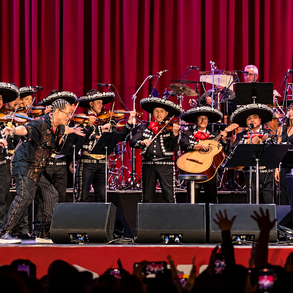








Two nights after playing Bellas Artes, Mike Patton took Mondo Cane to the Alhóndiga de Granaditas to open the Festival Internacional Cervantino. The repertoire was familiar, but the setting changed everything: less ceremony, more street-level energy and a Patton clearly enjoying just how far he could push his relationship with Mexico.
The Palacio de Bellas Artes and the Alhóndiga de Granaditas are separated by considerably more than a few hundred kilometres. Two nights after presenting Mondo Cane inside one of Mexico's most solemn cultural venues, Mike Patton stood before thousands in Guanajuato with essentially the same musical machinery but in an atmosphere bearing very little resemblance to the hush of a concert hall. It was Saturday, the 54th Festival Internacional Cervantino was officially beginning, the historic centre had been packed for hours and the heavy rain that had threatened the city in the preceding days had given way to far kinder conditions for an outdoor performance. The change of scenery suited a project that, for all its sophistication, has always been more entertaining when somebody allows its edges to get slightly dirty.
The Alhóndiga de Granaditas esplanade was already full before the concert, and a stage initially washed in red gradually filled with musicians before the third call announced Patton's arrival. Mondo Cane still has the appearance of a grand orchestral production capable of intimidating anyone whose knowledge of the singer begins and ends with Faith No More or Mr. Bungle: strings, brass, percussion, keyboards, guitars and voices spread across a massive ensemble, all working through Italian songs with more than half a century behind them. Yet it took only a few minutes for the formality to shrink to manageable proportions, largely because Patton appeared considerably more interested in talking to Guanajuato than in playing the distinguished international vocalist invited to open an arts festival.
Much of the Italian journey heard at Bellas Artes returned, with “Il cielo in una stanza”, “Che notte!”, “Urlo Negro”, “Deep Down”, “Lontano lontano” and “Senza fine” among the songs moving through a production that continues to demonstrate why Mondo Cane is considerably more than Patton pretending to be a crooner. There is no orchestra bolted onto these songs to make them appear important; orchestration is the project's bloodstream, allowing melodies born in another era to sound voluptuous, abrasive, romantic and occasionally threatening without stripping them of their original identity.
The Alhóndiga also provided something Bellas Artes simply couldn't: open air, noise, movement and a monumental stone wall throwing the music back towards a crowd under no obligation whatsoever to behave like a theatre audience. The strings could be negotiating an exquisitely arranged passage while Patton launched into one of his sudden register changes and somebody several metres away danced to an Italian song whose lyrics they almost certainly didn't understand. That disconnect never felt like a problem. If anything, it made the old material seem less like repertoire preserved for specialists and more like what these songs were in the first place: popular music intended to make people feel something before they began worrying about historical context.
Patton seemed equally keen to enjoy the geography. Somewhere along the way came an “¡Órale, Guanajuato!”, a dedication to El Pípila and an exchange with his musical director that abandoned whatever remained of festival-opening decorum. Patton's Spanish also produced a strategically deployed “No mames, güey”, which suggests that while he may not yet be ready to deliver a lecture on Spanish linguistics, he is more than adequately equipped for a Saturday night in Guanajuato.

His clothes had changed since Bellas Artes as well. Patton appeared in a shirt covered with calaveras, catrines and cempasúchil flowers, an obvious nod to Día de Muertos that could easily have slipped into tourist-shop territory had the rest of the show not demonstrated how seriously he had engaged with the Mexican material prepared for these dates. When “La Llorona” arrived, carrying its unavoidable connection to Chavela Vargas, the visual reference suddenly felt less decorative and more connected to the darker theatrical instincts that Mondo Cane can reveal whenever it moves away from Italian romance.
There was another important distinction from the show two nights earlier. At Bellas Artes, hearing this repertoire inside a room loaded with cultural history created an almost elegant tension between the architecture, the orchestra and Patton's notably disreputable musical CV. In Guanajuato, that contradiction largely disappeared because the Cervantino has spent decades encouraging countries, disciplines and audiences to collide in the same streets. An American musician obsessed with old Italian songs, surrounded by an international ensemble and preparing to finish with Mexican bolero and mariachi didn't look remotely out of place. It looked rather like a reasonable description of what an opening night at this festival should be.
The Mariachi Gama Mil pushed the final portion of the concert firmly through that door. “Luz de luna”, by Álvaro Carrillo, once again showed that Patton doesn't need to impersonate a traditional Mexican singer to understand what makes a melody of that size work. His pronunciation remains recognisably foreign and the drama in his voice belongs more to his own musical universe than to classic bolero, while the mariachi supplies a language that keeps the song anchored to its roots. It works precisely because nobody is pretending these musicians come from the same place.
By the time the opening phrases of “Hasta que te conocí” arrived, arguing about genres felt increasingly pointless. The mariachi triggered an immediate reaction and the esplanade ended up singing Juan Gabriel alongside Patton, repeating what had happened at Bellas Artes but with one crucial difference: there were no seats and no ornate concert hall imposing distance. The Alhóndiga behaved like an outdoor space filled with people who had come to open the Cervantino and suddenly found themselves dancing to a song embedded deeply within Mexican popular culture, performed by the same man responsible for some of the least predictable choices in American alternative music.

It is tempting to frame all of this as further evidence of Mike Patton's celebrated “versatility”, although that word does less and less to explain why any of it works. Being able to sing in several styles doesn't automatically give someone the judgement required to combine them, and Mondo Cane survives because beneath the eccentricity sits a fairly serious understanding of the songs themselves. Patton can play with them, distort certain inflections and insert his own personality, but he rarely behaves as though he is somehow above the material. The orchestra approaches it in much the same fashion; in Guanajuato, strings moved physically with the music and the arrangements travelled through Italian pop, rock, noise and bolero without making the evening resemble a genre sampler.
Choosing Mondo Cane to open the Cervantino consequently made far more sense in practice than it might have on a programme. The 54th edition brings together thousands of artists from dozens of countries and is built around exchanges unlikely to remain inside a single tradition, so beginning with an American singer reconstructing Italian songs before wandering into Chavela Vargas, Álvaro Carrillo and Juan Gabriel was almost suspiciously appropriate.
Bellas Artes had revealed the more elegant and intimate side of this repertoire two nights earlier; Guanajuato allowed it to breathe differently. The walls of the Alhóndiga threw decades-old Italian songs back over a crowded esplanade, Patton abandoned most remaining traces of protocol to joke with the audience, and the Mexican section stopped feeling like a surprise saved for an encore and became part of a much larger celebration. There is a considerable musical and geographical distance between “Il cielo in una stanza” and “Hasta que te conocí”, yet for roughly 90 minutes Mondo Cane travelled it without needing to explain the route.
The image that best captures the evening probably isn't Patton showing the extent of his voice or a huge orchestra performing in front of one of Mexico's most recognisable historical monuments. It is the Alhóndiga singing Juan Gabriel while a Californian wearing calaveras and cempasúchil, backed by a mariachi, looks entirely comfortable in the middle of it. For someone who has spent much of his career walking into musical spaces where he theoretically shouldn't belong, there were considerably worse ways to open the Cervantino.