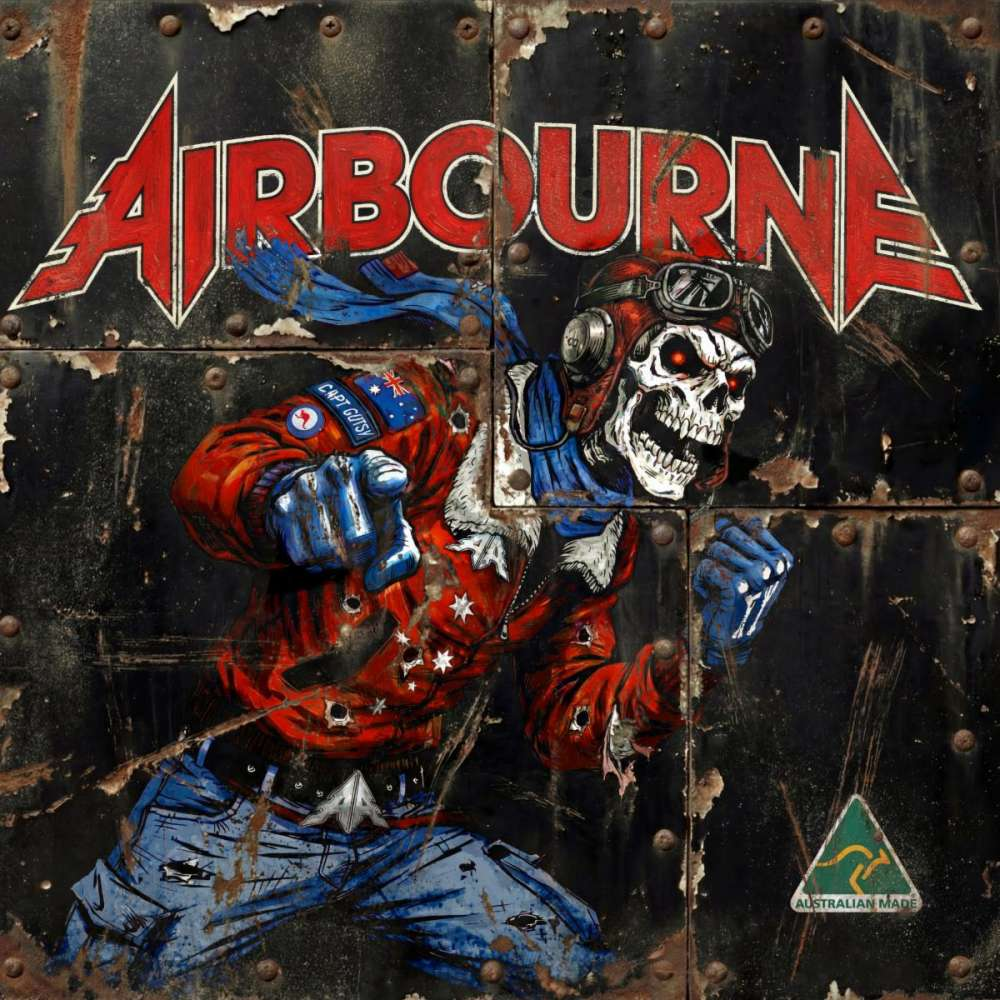



For almost twenty years, Airbourne have been answering a question they probably never cared to ask: how long can a band survive inside such a deliberately restricted language without becoming a caricature of itself? Since Runnin’ Wild, the Australians have built their identity around a handful of elements that have barely changed: riffs derived from seventies and eighties Australian hard rock, pounding drums, choruses designed to be shouted with a beer in hand, and Joel O’Keeffe singing as though every night might end with an amplifier catching fire. Their sixth album, simply titled Airbourne, makes no attempt to alter that definition and seems equally uninterested in explaining why it should still work. The relevant question is whether enough life remains inside that formula to sustain another complete record, and the answer is considerably more positive than such stylistic immobility might suggest.
Choosing a self-titled name after two decades makes sense because this album feels conceived as a conscious distillation of everything Airbourne considers essential. The band reunited with Brian Howes and Mike Fraser, recorded at Music Farm Studio through the former Alberts Studios Neve console historically associated with recordings by AC/DC, Rose Tattoo and The Angels, and later placed the mix in the hands of Zakk Cervini. The symbolism could have become excessively reverential for musicians whose entire career has already been compared with AC/DC, but the record avoids becoming a museum piece because the performances retain a physical energy that is difficult to fake.
“GUTSY” opens the album with enough conviction to remind us that originality has never been Airbourne’s primary strength. Joel O’Keeffe still understands the riff as a propulsion mechanism rather than a technical demonstration, while the rhythm section retains a dry impact that lets the guitars hit without being buried by the production. The sound is large and considerably more polished than on the early records, yet Cervini avoids sanding away all the abrasion the band requires. The guitars retain bite, the drums are exaggerated but still physical, and the vocal remains rough enough to keep the recording from feeling like an overly elegant reconstruction of pub rock.
That balance is essential because Airbourne depends on a form of music whose effectiveness can disappear quickly once production begins correcting too much. A song such as “Alive After Death (Last Plane Out)” needs to communicate motion before precision, and the band preserves the sensation of musicians playing together even when every element is perfectly defined. The song also introduces one of the few themes that slightly expands O’Keeffe’s usual range, using the permanence of music after death as a way of remembering rock figures who continue to live through their songs. The same idea returns near the end on “Send Me To Rock ’N’ Roll Heaven,” where Lemmy, Bon Scott, John Bonham, Little Richard and Doc Neeson become part of a farewell that naturally fits Airbourne’s almost religious understanding of rock.
Reverence for the past runs throughout the album, although it is not equally interesting at every point. Airbourne have never hidden their debt to AC/DC and it would be absurd to demand that their sixth record suddenly begin doing so, but certain progressions, guitar tones and structures occasionally come so close to that model that the band’s own personality depends almost entirely on the energy of the execution. The line between influence and repetition remains deliberately narrow, and Airbourne works whenever O’Keeffe and company compensate through speed, attitude or a sufficiently strong chorus.
“Here She Comes” offers a small but significant variation within that framework. Written with Bryan Adams and Mutt Lange, the song carries a more disciplined melodic construction and a compositional economy that feels slightly different from the band’s usual approach. It does not transform Airbourne into another group and makes no attempt to do so, but it demonstrates that their formula can benefit from external discipline capable of organizing the material without neutralizing its personality. The chorus has obvious immediacy and the song avoids becoming overloaded, allowing melody and riff to share space without constantly competing for attention.
“Kid In A Candy Store” and “Sky High” return to much more familiar territory, including the sexual double entendres that have accompanied Airbourne since their earliest years. Here one of the album’s clearest limitations becomes apparent because the lyrics continue operating within a deliberately adolescent universe where sex, alcohol, the road and rock and roll remain practically the only available subjects. Part of Airbourne’s appeal lies precisely in that lack of sophistication and it would be strange to demand existential introspection in the middle of a riff designed to make a festival crowd jump, although after six albums some of those images begin feeling less like identity and more like habit.
The band finds greater freshness when concentrating on groove. “Who Put The Rhythm In You?” slightly reduces the need to move at maximum speed and allows a more flexible relationship between guitar, bass and drums to emerge. The riff retains the familiar DNA, but the song breathes more effectively and demonstrates that Airbourne can alter dynamics without abandoning its coordinates. Those kinds of small variations are more useful than any artificial attempt to import foreign sounds because the band never needed electronics, orchestration or radical genre shifts to reinvent itself; it simply needs different ways of moving the same body.
“Christmas Bonus” carries that irreverence toward almost absurd territory, although its presence makes sense within a record that never confuses seriousness with importance. Airbourne understands rock as a physical, communal and slightly ridiculous experience, a perspective that allows certain lyrics to survive precisely because the band does not expect them to be interpreted as profound declarations. The difficulty emerges when too many songs rely on the same kind of humor and occupy an almost identical emotional space, reducing the album’s ability to generate contrast.
“Last Man Standing” helps restore some of that difference through a stubbornness that seems written specifically for Airbourne’s own career. The song turns endurance into a natural extension of O’Keeffe’s persona and works because the band can sing about remaining upright without inventing a heroic narrative. After nearly two decades defending a form of hard rock frequently treated as anachronistic, persistence no longer feels like a pose and acquires a certain autobiographical weight. The same impulse runs through “Hells Got No Vacancy,” where the aggression of the guitars and rhythm prevents the lyric from functioning simply as another slogan.
“Rock ’N’ Roll Ya” pushes that self-definition toward an almost comic extreme while accurately summarizing Airbourne’s nature. The band does not regard rock and roll as a genre requiring constant reinterpretation, but as a tradition that can remain alive through volume, sweat and execution. That position may be conservative, yet it is completely coherent. The record never attempts to manufacture modernity through cosmetic decisions and does not adapt its sound to contemporary hard-rock trends; modernity exists primarily in the clarity of the mix and the scale of the production, while the music continues operating according to a much older logic.
“Bogotá” introduces a different detail by transforming a road experience into a song and temporarily allowing the album to move beyond its more abstract themes of rock, sex and endurance. Specificity suits O’Keeffe and reveals how much Airbourne could gain by using more concrete stories accumulated through two decades of traveling the world. The band presumably has enough absurd, dangerous and memorable episodes to expand its lyrical universe without changing anything about the music, and “Bogotá” demonstrates that greater specificity does not require abandoning simplicity.
The final sequence concentrates much of the album’s nostalgic dimension. “Hells Got No Vacancy” maintains the energy while “Send Me To Rock ’N’ Roll Heaven” turns admiration for fallen heroes into a kind of celebratory funeral. The song directly references several figures fundamental to Airbourne and avoids the solemnity that would have felt incompatible with the group. Death is viewed through the same logic governing the rest of the record: as long as the songs continue being played, the people who created them remain part of the culture they left behind.
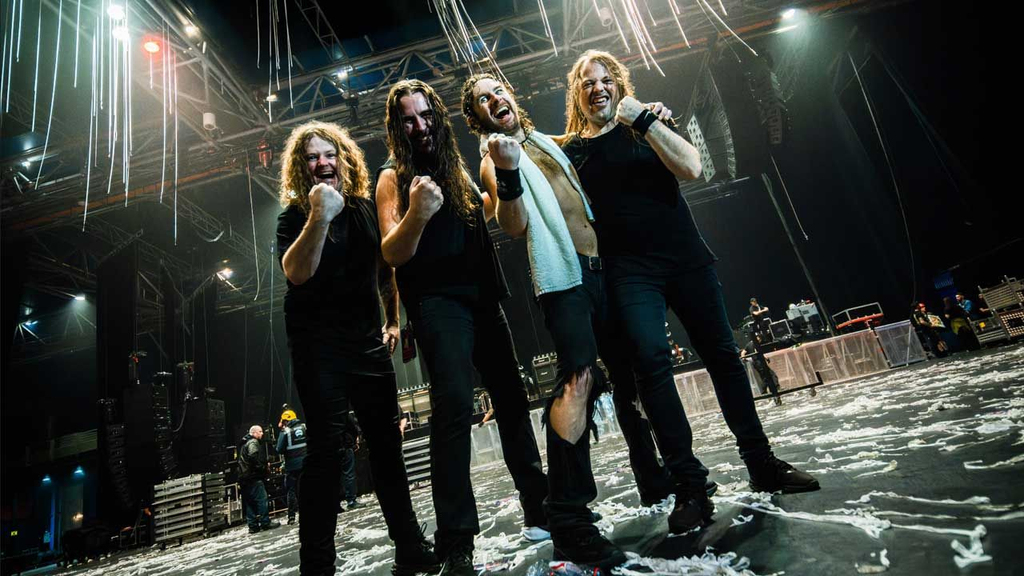
That ending also helps explain why Airbourne continues making music in practically the same manner. Continuity does not seem equivalent to stagnation for them because tradition forms part of the purpose. The critical problem is that coherent intention does not guarantee that every song carries equal strength. There are passages where the similarity between tempos, progressions and choruses begins eroding the initial impact, and the second half could have benefited from slightly more aggressive editing. Twelve songs and approximately forty-seven minutes are not excessive, but this form of hard rock works best when urgency is preserved, something that can weaken when too many compositions share the same intensity.

The production prevents that fatigue from becoming more severe. Fraser and Cervini achieve a highly effective balance between contemporary weight and classic texture, using modern clarity without making the recording clinical. The bass retains enough presence to support the guitars, while the drums possess a body that particularly benefits moments where Airbourne slightly reduces the tempo. O’Keeffe’s voice naturally occupies the front without becoming so detached from the instruments that the band feels like mere accompaniment.
It is also significant that Airbourne does not present its lack of evolution as a provocation. The album does not appear constructed to prove that traditional rock remains superior to modern music and has no need to enter a generational argument. The musicians play what they know because they still believe in it, a subtle but important difference from nostalgia exercises that depend on turning the past into an argument from authority.
That authenticity, understood not as purity but as consistency between intention and execution, allows highly conventional songs to retain impact. When “GUTSY,” “Here She Comes” or “Last Man Standing” find the right riff, familiarity stops mattering for several minutes because the physical response arrives before analysis. A full album requires greater contrast than a concert or isolated song, however, and Airbourne continues confronting the same limitations that have always accompanied its approach.
The self-titled name ultimately proves appropriate precisely because it does not announce transformation. Airbourne summarizes the band accurately: energetic, excessive, deeply traditional and convinced that a simple riff can still justify four minutes of music when played with enough force. Anyone expecting reinvention is probably looking in the wrong place, while listeners willing to accept the rules will find one of the more consistent records of the band’s recent period.
The absence of major surprises does not mean everything becomes interchangeable. “Here She Comes” clearly benefits from a different melodic construction, “Who Put The Rhythm In You?” finds a particularly effective groove, “Bogotá” uses a concrete experience to temporarily escape familiar lyrical territory and “Send Me To Rock ’N’ Roll Heaven” introduces an affectionate dimension that few Airbourne songs have developed with comparable clarity. Those differences may be small compared with the evolution of other bands, but within such a restricted language they become significant enough to keep the album from becoming an exact repetition of previous records.
The principal limitation remains the lyric writing. O’Keeffe has enough charisma to make phrases work that would sound almost parodic in another voice, although the continued fixation on sex, alcohol, rock and roll and survival unnecessarily reduces the world available to the band. “Bogotá” and the songs dedicated to deceased musicians demonstrate that Airbourne can retain simplicity while introducing personal experience, memory and greater specificity, a direction that could enrich future albums without altering its musical identity.
Within those boundaries, Airbourne accomplishes something fairly difficult: making a band that practically refuses to evolve still sound alive. The performance prevents familiarity from becoming complete routine, the production understands the necessary balance between polish and dirt, and the strongest songs possess the kind of chorus that explains why this group continues working so well in front of large crowds. The formula has obvious limits and the album does not overcome them, but neither does it become completely trapped inside them.