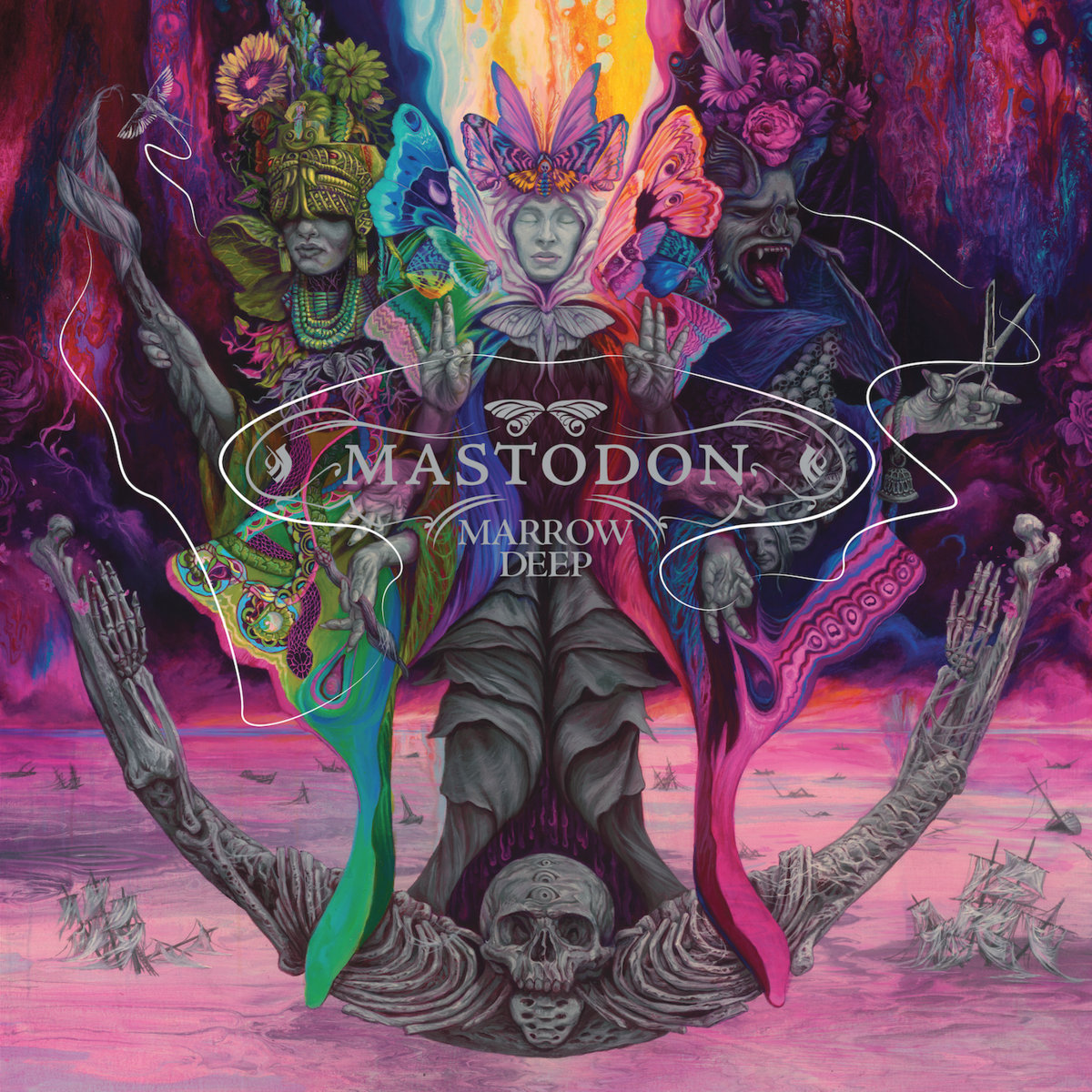



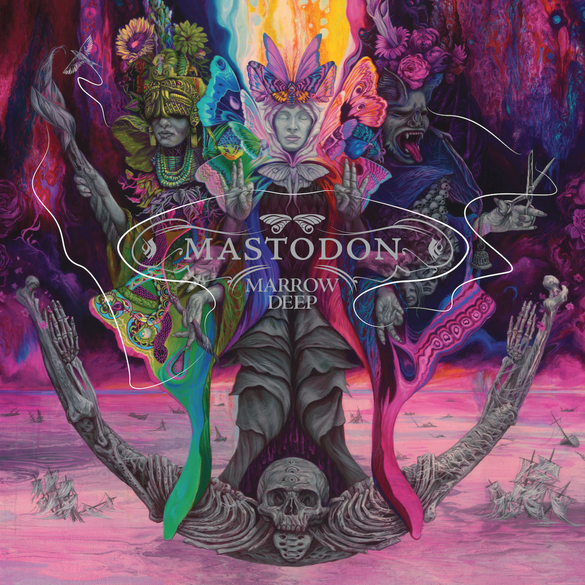
Brent Hinds’ absence could have turned Marrow Deep into an impossible problem to solve. For twenty-five years, his guitar had been one of the forces preventing Mastodon from ever becoming entirely comfortable inside its own music, introducing blues, country, psychedelia and a strangely intuitive way of placing notes where other guitarists would probably have searched for something more elegant. His departure from the band in March 2025 already represented a historic rupture; his death in a motorcycle accident five months later inevitably transformed any new Mastodon music into something that would be heard through that loss. Added to this was Brann Dailor’s grief over the death of his mother, Michele J. Lawrence, meaning the band’s ninth album arrived surrounded by enough pain to consume almost any strictly musical conversation about it.
What is remarkable about Marrow Deep is that Mastodon does not attempt to resolve that situation by pretending nothing changed or by constructing a sixty-plus-minute monument around those who are no longer here. Death runs through the album, as it has so often throughout the work of a band that turned personal losses into part of Crack the Skye, The Hunter, Emperor of Sand and Hushed and Grim, but there is another, more immediate concern here: discovering what kind of Mastodon can exist when one of the personalities responsible for its creative instability is no longer part of the equation. The result contains moments of explicit grief, although its most interesting quality comes from hearing the musicians reorganize an identity that depended for decades on four very different temperaments.
The first response is to recover an aggression that had been appearing more intermittently for some time. Hushed and Grim contained great songs, but its nearly ninety-minute running time allowed melancholy and atmospheric development to expand until parts of the experience became exhausting. Marrow Deep cannot exactly be described as brief either, with twelve songs and a running time of more than an hour, but the difference lies in the energy with which Mastodon occupies that time. “Barbarians Blood” and “Poisonous Weapons” possess a physical heaviness that recalls how much this band can accomplish when Bill Kelliher finds a riff capable of carrying the composition before all the additional layers arrive, while Brann Dailor plays with an activity that recovers some of the danger from the years when his fills seemed to be attempting to escape the songs.
That movement toward a heavier Mastodon does not mean the band has attempted to reconstruct Leviathan with different musicians. References to its past appear constantly, although they are filtered through twenty years of progressive evolution and through a lineup whose chemistry has necessarily changed. Guitarist Nick Johnston and keyboardist João Nogueira participate in the album alongside Dailor, Troy Sanders and Kelliher, and their arrival changes the internal space of the songs in fairly obvious ways. Nogueira’s presence extends far beyond providing atmospheric backgrounds, while Johnston introduces a precision and progressive vocabulary that fit Mastodon’s more expansive side without attempting to literally reproduce Hinds’ playing.
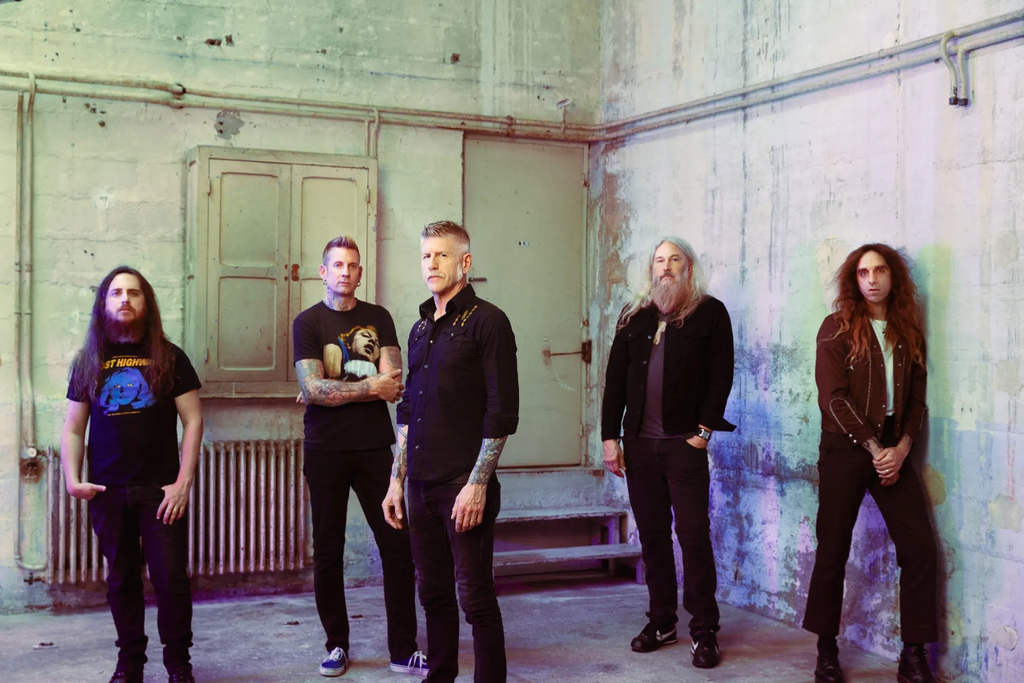
That difference should not be understood as a competition between the two guitarists, because attempting to find a stylistic replacement for Hinds would probably have been the least interesting decision available. Marrow Deep works best when it accepts that the geometry of the band has changed and uses Johnston and Nogueira to construct something around that absence rather than covering it. “Your Ghost Again” concentrates much of that transition: it possesses a twisted, urgent riff that could be associated with the Mastodon of Blood Mountain, but synths, vocal melodies and a structure belonging unmistakably to the adult band appear around it. The lyrics introduce grief without turning it into an overly tidy elegy, preserving the uncomfortable combination of affection, regret and matters death left with no possibility of resolution.
Mastodon has always written more effectively about death when it avoids turning it into a lesson. On its strongest records, pain tends to produce worlds, characters and musical movement rather than reassuring messages, and Marrow Deep recovers some of that ability. The relationship with Hinds had ended under complicated circumstances before his death, preventing grief from being comfortably reduced to nostalgia. That ambivalence gives the album a far more interesting emotional charge than a straightforward tribute could have provided, because behind the loss there is also guilt, exhaustion, affection, frustration and the awareness that some conversations can no longer take place.
Troy Sanders’ voice becomes particularly important within that context. His rough register gives “Poisonous Weapons” and several of the album’s heavier moments substantial gravity, while Dailor more naturally occupies the melodic territory the band has spent years expanding. The absence of Hinds’ nasal, fractured voice inevitably changes the vocal triangle that gave Mastodon such an unusual identity, although the relationship between Sanders and Dailor now acquires a different kind of clarity. The melodies can feel less unpredictable, but there is also greater cohesion between voices and arrangements, a tradeoff that summarizes much of the album: the new Mastodon gains control while losing some of its former volatility.
Dailor’s drumming is probably the element that connects both eras most successfully. Throughout some of the more recent albums, he had learned to contain the impulse to fill every available space, a necessary evolution for the music Mastodon was writing, while Marrow Deep allows him to recover a much more restless performance without abandoning that maturity. “Golden Spires” is one of the places where that combination becomes especially apparent, with patterns and fills continuously shifting the rhythmic center without turning the song into a technical demonstration. The difference may appear subtle, but it substantially alters the overall feeling of the record because Mastodon recovers movement even when the riffs operate at less accelerated tempos.
The abundance of guests could have turned the album into an overcrowded celebration, although most of them are integrated into the personality of the songs. Josh Homme returns on “Snakes for Dinner,” Neil Fallon appears on “The Three Fates,” Randy Blythe and Nate Newton contribute to “A Vampire’s Demeanor,” while “The Vanishing” brings together Geezer Butler and Joe Duplantier. The weight of those names is considerable, but the most effective collaborations are the ones that genuinely alter the texture. Butler introducing “The Vanishing” possesses a musical logic extending beyond the excitement of hearing Black Sabbath’s bassist on a Mastodon record, while Duplantier’s later appearance provides a vocal violence that pushes the composition somewhere else without breaking its atmosphere.
“The Vanishing” consequently becomes one of the emotional centers of Marrow Deep because the band allows grief to remain inside the music rather than constantly explaining it. Its running time exceeds six minutes and the development has enough room to change weight and perspective, recalling that Mastodon can remain progressive without depending on permanent complexity. The progression works because there is an emotional necessity behind the movements, while the combination of guest musicians expands a song that already possessed its own structure before they arrived.
Not every expansion on the album carries the same justification. Marrow Deep loses some tension during its second half when certain compositions begin using breadth as an end in itself. “They’re Coming for You” develops a midtempo psychedelia containing interesting details but takes too long to find a sufficiently strong direction, while “Moth and Bone” participates in a similar tendency. The issue becomes clearer on “The Three Fates,” where increasingly jazz-oriented keyboards and the space granted to solos extend the conclusion until the sensation of traveling begins competing with the need to actually arrive.
Those passages are where Hinds’ absence acquires a strictly musical dimension. His value within Mastodon never consisted solely of playing memorable solos; he could also introduce a crooked idea capable of destabilizing a section before it became too comfortable. Johnston and Nogueira provide new resources and will probably make considerable evolution possible on future albums, although there are still moments on Marrow Deep where sophistication occupies the space that might once have contained a less logical decision. The band sounds more functional and focused, but that stability comes with a cost the album itself is still learning how to calculate.
The running time also deserves some resistance. Compared with Hushed and Grim, Marrow Deep has a far more manageable structure and a greater proportion of songs that justify their space, although exceeding an hour remains a considerable decision for an album that occasionally appears to be searching for renewed urgency. Trimming some of the less essential developments from the second half would have intensified the effect of “A Vampire’s Demeanor” and “The Vanishing” while allowing the ending to carry greater weight. Mastodon remains a band capable of making seven minutes feel necessary when it finds the right idea, but that ability does not automatically transform every expansion into depth.
The production helps sustain much of that length by maintaining unusual separation for a record containing so many layers. Sanders’ bass retains body, the guitars can accumulate without turning everything into an indistinguishable mass and Dailor’s drums retain enough physical presence for the rhythmic details to survive underneath keyboards and effects. Density has belonged to Mastodon for a very long time, but it is managed with greater clarity here than during some sections of Hushed and Grim, allowing even the less convincing compositions to contain interesting elements inside the mix.
It is also significant that Marrow Deep does not attempt to turn the return of heaviness into nostalgia for the band’s earliest albums. References to Leviathan or Blood Mountain become inevitable whenever more violent riffs appear and Dailor recovers some of his hyperactivity, but the Mastodon of 2026 cannot and should not sound like four musicians in their thirties discovering how far they could distort sludge metal. Melody now occupies too much space within the band’s identity, Sanders and Dailor have changed as vocalists and keyboards introduce possibilities that did not exist during that period. The album finds strength when it uses the past as muscle memory rather than as a template.
For that reason, Marrow Deep is more convincing as a beginning than as a restoration. It does not recover classic Mastodon because that group depended on a chemistry that no longer exists, and it does not yet present a completely defined identity for the current lineup. What it offers is something more honest: experienced musicians discovering which parts of their language still belong to those who remain, which disappeared with Hinds and which can be transformed through the presence of Johnston and Nogueira.
That process explains some of the irregularities without automatically turning them into virtues. There are solos that could have been shorter, progressive transitions that feel too comfortable and moments where the new instrumental precision reduces the sense of danger that historically made Mastodon fascinating. There is also a band playing with an energy it had not sustained across such a large portion of an album for some time, with Dailor, Sanders and Kelliher appearing less interested in preserving a legacy than in discovering how much of it can change while still belonging to them.
Grief provides context, but using it as protection against criticism would be unfair. Marrow Deep deserves to be evaluated as Mastodon’s ninth album rather than merely as the record they managed to complete after a series of devastating losses. From that perspective, it remains one of the strongest works of their later period, clearly more concentrated than Hushed and Grim and carrying an aggression that restores friction to a sound that had begun settling too comfortably into progressive melancholy. Its strongest songs possess enough weight to coexist honorably with the older catalog without depending on the story surrounding their creation.
Placing it alongside Leviathan, Blood Mountain or Crack the Skye would still be excessive. Those albums captured a band discovering possibilities it did not yet know how to control, and part of their greatness comes precisely from the feeling that everything might collapse while moving forward. Marrow Deep belongs to far more experienced musicians who understand their craft too well to reproduce that kind of creative innocence. What they can do now is find another form of uncertainty, and the change in lineup has imposed one that nobody involved would have chosen.
Hinds’ presence is felt precisely because Mastodon avoids replacing him with an imitation. There are moments where his phrasing is missed, others where the music benefits from a discipline he might have disrupted and some where both sensations exist simultaneously. That contradiction is considerably more interesting than attempting to decide whether the band is better or worse without him, because Marrow Deep does not yet provide a definitive answer and has no need to manufacture one.
By the end of the album, the experience resembles a genuine transition with all the discomfort that implies. Mastodon has recovered some of its physical force, Dailor is again playing with extraordinary ferocity, Sanders occupies more space and the arrival of Johnston and Nogueira opens possibilities that are only beginning to take shape. At the same time, certain progressive passages are too conventional for a band that spent years turning strangeness into a virtue, and the second half would have benefited substantially from more severe editing.
Within those contradictions, a different Mastodon begins to emerge while retaining enough of the previous band’s DNA to remain recognizable. Marrow Deep does not attempt to close the grieving process or resolve Brent Hinds’ absence, and its greatest achievement lies in allowing that absence to remain inside the music while the band begins constructing around it. After twenty-five years, a transformation of this magnitude could easily have produced a cautious version of Mastodon dedicated to protecting whatever remained; instead, it has produced a heavy, emotionally complicated and sufficiently imperfect album to suggest that this new era still contains unknown places worth exploring.