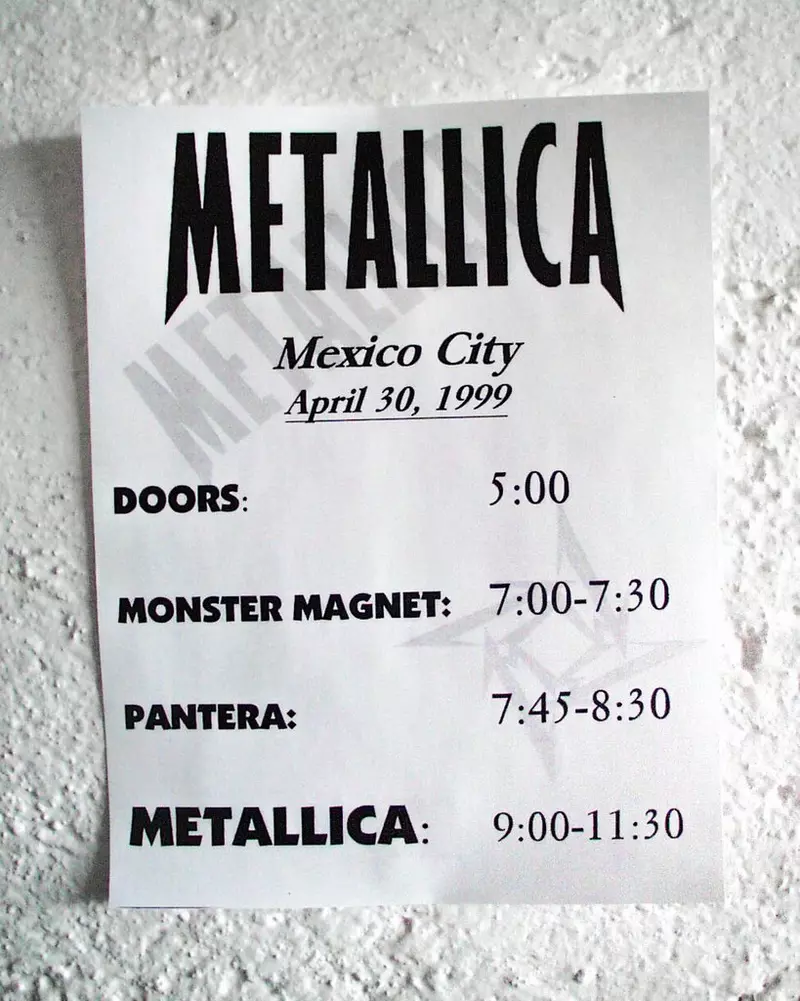
On April 30, 1999, at the Foro Sol in Mexico City, two of the most decisive bands in the history of modern metal crossed paths on the same stage: Metallica, by then a mass-reach machine following the commercial phenomenon of the Black Album, and Pantera, the Texan outfit that had redefined groove metal since Cowboys From Hell and that, by the end of the decade, carried the authority of having been the most influential extreme-metal band of the nineties in the United States. The date wasn't a metal festival in the sense we understand that term today, nor a planned co-headlining tour with equivalent billing: it was a single night within The Garage Remains the Same Tour, the run of shows with which Metallica was promoting Garage Inc., the covers album released in 1998. But the fact that Pantera — at creative full strength and at the most intense point of its relationship with Latin American audiences — opened that night, alongside Monster Magnet, turned what could have been just another stop on a touring band's schedule into an event that, more than two decades later, is still cited as an obligatory reference point in any conversation about the history of metal in Mexico. It wasn't only the musical quality of what happened onstage, which was remarkable, but the way that night functioned as a hinge between two eras: the era of Mexican metal built by sheer will, in street markets, fanzines, and improvised venues, and the era of metal as a professionalized mass-entertainment industry, with security protocols, sponsorships, and recurring tours that we now take for granted. Understanding that crossroads requires first looking at the ground that night fell on, then reconstructing with precision what happened at the Foro Sol on April 30, 1999, and finally assessing with critical distance the legacy it left behind — a legacy that extends far beyond the flying-chairs anecdote through which the episode is usually summarized. It's also a story worth telling now with the rigor that distance allows, because much of what happened that night still circulates in fragmentary versions, scattered across fan chronicles, brief press notes, and oral accounts passed down from one generation of Mexican metalheads to the next, without there having existed, until now, an effort to bring those sources together into a single, ordered, verified account.s
The Ground That Was Laid: How Mexican Metal Got to 1999
To gauge what it meant to see Metallica and Pantera sharing a stage in Mexico, it's essential to reconstruct, even in broad strokes, the road the Mexican metal scene had traveled up to that point. Rock in general, and metal in particular, did not enjoy a favorable institutional environment in Mexico for much of the twentieth century. After the Avándaro festival in 1971, authorities imposed an informal but effective clampdown on rock music in public spaces and mass media, a clampdown that persisted, with some nuance, through nearly all of the seventies and much of the eighties. Within that restrictive context, the Mexican heavy rock and metal scene developed on the margins, in hoyos funky, cultural centers, university auditoriums, and party halls converted into makeshift venues, sustained by a network of fans, independent promoters, and bands that recorded and distributed their material by hand. The book Cimientos del Metal Mexicano 1968-1995, by researcher and fanzine editor Vicente Terán Flores, documents precisely that process: a scene built chapter by chapter, city by city, from the metropolitan area to Guanajuato, Jalisco, Morelos, and the country's southeast, sustained by musicians, promoters, and followers who lacked the commercial infrastructure that did exist for this kind of music in the United States or Europe.
One of the organizing hubs of that scene was, without a doubt, the Tianguis Cultural del Chopo, founded in the early eighties by cultural promoter Jorge Pantoja as an extension of the work of opening up space for rock at the Museo Universitario del Chopo, part of UNAM, after years of government hostility toward the genre. Every Saturday, in the Santa María la Ribera neighborhood, El Chopo became the meeting point where the punk, metal, goth, ska, and indie scenes converged, and where vinyl records, cassettes, T-shirts, jackets, fanzines, and all the paraphernalia that gave those communities their identity circulated. The arrival of the nineties found that market already established as an obligatory reference point, and it also found, as chronicled by La Jornada's account of its history, a rock scene that had finally struck hard in the country, with audiences from different musical genres coexisting in the same space, in a social moment additionally marked by the uprising of the Zapatista Army of National Liberation, which reactivated a more combative and politically conscious streak in several bands and cultural collectives. It was there, at El Chopo's stalls, where Mexican metalheads got fanzines like Vida y Muerte or Umbral, publications made with typewriters, photocopiers, and a great deal of stubbornness, which functioned as the only reliable channels of information about foreign bands in a country where specialized music press was scarce and where no form of digital access to information yet existed.
Alongside the network of street markets and fanzines, a handful of radio spaces emerged during those same years that served as an additional sounding board for the metal community, in a country where mass commercial radio rarely programmed this kind of music. Stations like Rock 101 became, for much of that generation, the most reliable source of information about tours, releases, and news from the international rock and metal circuit, to the point that chronicles written decades later by attendees of Metallica's 1993 concerts still recall with precision the bulletins broadcast by that station the night before the shows, as if the radio confirmation of the event were, in itself, part of the collective experience of waiting for a band of that magnitude to arrive. That combination of street markets, fanzines, and specialized radio operated as an informal but surprisingly effective infrastructure of cultural dissemination, capable of sustaining the interest and loyalty of a community of fans even without the backing of a record or entertainment industry that systematically invested in the genre, and it was precisely that infrastructure that guaranteed that, when the opportunity for a bill the size of the one that brought together Metallica and Pantera in 1999 finally arrived, the audience's response didn't have to be built from scratch, but rather activated on a foundation of knowledge and expectation accumulated over nearly two decades.
Within that ecosystem, the arrival of foreign metal bands on Mexican soil was an infrequent event and, when it did happen, was usually limited to mid-tier acts that performed at venues like Arena López Mateos, known within the metal community as a genuine cathedral of the genre for much of the eighties and nineties. Bands played there ranging from relatively young acts still without much of a track record, like Vicious Rumors, Demolition Hammer, or Devastation, to acts that would later become cult favorites, and for much of a generation of fans, those shows represented the first physical, face-to-face contact with a kind of music they had until then only known through recorded cassettes, transnational magazines obtained with enormous difficulty, and word of mouth from other fans. The difference between reading about an extreme concert in a foreign magazine and witnessing it live, moshing and risking a stage dive while dodging security, was abysmal, and that direct experience shaped tastes, codes of behavior, and a sense of belonging that would later carry over, multiplied, to the big venues.
Before moving on, it's worth pausing on the specific weight Pantera carried within that community by the end of the nineties, because it explains in large part why their presence on the Foro Sol bill was just as significant as Metallica's, and not simply a filler opening act. Pantera had formed in Arlington, Texas, in 1981, at the initiative of the Abbott brothers — Darrell, who years later would adopt the nickname Dimebag Darrell, on guitar, and Vinnie Paul on drums — initially joined by Rex Brown on bass and Terry Glaze as vocalist, in an early stage marked by glam metal and openly declared influences from Kiss and Van Halen. The arrival of Phil Anselmo as singer in 1987 completely changed the band's direction, moving away from that eighties aesthetic toward a rawer, heavier sound, a process that crystallized in 1990 with Cowboys from Hell, an album that specialized critics tend to point to as the true birth of the band's mature style and which was influenced, as its own members acknowledged, by direct contact they'd had with Metallica, Slayer, and Black Sabbath on shared tours and stages in prior years. Two years later came Vulgar Display of Power, released in February 1992, an album that finished consolidating Pantera's signature sound and that today is considered, almost unanimously among critics and musicians of the genre, one of the foundational records of groove metal, with tracks like Walk, Mouth for War, and This Love becoming essential reference points for an entire generation of bands that followed. By 1994, with the release of Far Beyond Driven, which debuted directly at number one on the Billboard 200 in the United States, Pantera had become one of the most commercially successful bands in metal worldwide, at a moment when much of the American music industry had turned its attention toward grunge and alternative rock, which led more than a few specialized journalists to credit the Texan band with having kept heavy metal alive as a mass genre during a decade that was particularly hostile to the style. Arriving in Mexico in 1999, then, was no ordinary visit: it was the arrival of one of the bands that, together with Metallica, defined at that precise moment what metal meant on a planetary scale, and the Mexican audience knew it perfectly well.
The real watershed moment in terms of scale came in 1993, when Metallica performed in Mexico for the first time, with five consecutive concerts at the Palacio de los Deportes between late February and the first days of March, as part of the Nowhere Else to Roam tour that accompanied the commercial success of the band's self-titled 1991 album, popularly known as the Black Album. Those five nights, organized by OCESA, marked the beginning of a relationship that, over the years, would turn Mexico into one of the band's most loyal markets worldwide, and one of those shows, the one on March 2, was recorded for the box set Live Shit: Binge & Purge, released that same year, which gave those shows an unusual documentary permanence for a concert held in a country that, until then, had not figured prominently in the itineraries of major rock and metal tours. The band played to audiences that combined songs from Ride the Lightning, Master of Puppets, and ...And Justice for All with material from the Black Album, in an atmosphere that, according to the testimonies of attendees, had less to do with the logistical professionalism we associate with major concerts today and more with a collective fervor among people who had spent years waiting to see a band of that magnitude live. James Hetfield even performed covers such as Last Caress by Misfits, Am I Evil? by Diamond Head, and Stone Cold Crazy by Queen, the latter a song he had played just a year earlier at the Freddie Mercury tribute alongside Tony Iommi, which added an extra layer of significance to those Mexican nights within the band's trajectory during that period.
Six years separate that first contact in 1993 from the joint concert with Pantera in 1999, and during that interval Mexico's concert industry underwent a notable, though still incomplete, transformation. OCESA, the promoter that had organized the 1993 shows, was consolidating a business model that made it increasingly viable to bring large-scale productions into the country, and the landscape of venues available for mass concerts began to expand, with the Foro Sol emerging as an option capable of holding considerably larger audiences than the Palacio de los Deportes. However, that expansion in capacity and infrastructure was not always accompanied by an equally sophisticated understanding of what it took, in terms of security and logistics, to organize a metal and hard rock concert for tens of thousands of people. It was precisely that gap between the ambition of the production and the real understanding of the audience being summoned that ended up defining much of what happened that April night in 1999, when two of the genre's most important bands performed together before a Mexican audience that, by then, was no longer the same one that had attended the 1993 shows: it was a larger audience, more connected to itself through years of street markets, fanzines, and radio stations like Rock 101, and carrying an accumulated hunger to see live the bands that had defined its adolescence.
The Night at the Foro Sol: Chronicle of a Concert That Became Legend
That night's bill, within The Garage Remains the Same Tour, brought together three acts with very different onstage temperaments: Monster Magnet, the stoner and space-rock band led by Dave Wyndorf, opening the evening; Pantera, in a relatively brief but overwhelmingly intense set; and Metallica closing the night with an extensive repertoire that combined unavoidable classics with more recent material. According to the testimonies of attendees gathered in various chronicles published in subsequent years, Monster Magnet took the stage around 7:03 p.m. and delivered a set of roughly forty-five minutes that, against the expectations of much of the crowd, who weren't as familiar with the band as with the other two acts, turned out to be surprisingly effective at warming up a crowd that already numbered around fifty thousand people inside the venue. It was, worth remembering, an era without camera phones, without social media, and without the ability to verify information about the event in real time; the news that Metallica and Pantera would perform together in Mexico had spread through newspapers, specialized magazines, and radio and television programs for weeks beforehand, generating an anticipation that kept building without the informational release valves we now consider normal.
When Pantera took the stage, the atmosphere shifted noticeably. Phil Anselmo greeted the Mexican audience and, according to the chronicles of those present, promised an unforgettable night, in a tone aimed at generating immediate rapport with a crowd that already knew albums like 1992's Vulgar Display of Power by heart and had spent years waiting to see the band live in the country. Pantera's set, just eight songs long and without an encore, opened with Domination and continued with tracks like Suicide Note Pt. 2, Primal Concrete Sledge, Fucking Hostile, and This Love, closing with Cowboys From Hell, one of the most recognizable anthems in their catalog. It was during the opening chords of that set that the episode occurred which, for better or worse, ended up defining the collective memory of that night: the Foro Sol's floor section had been laid out with chairs arranged in rows and secured to one another with plastic zip ties, a numbered-seating scheme designed for a type of show that clearly didn't correspond to the physical, collective nature of a metal concert of that magnitude. As soon as Pantera's first riffs sounded, the crowd began ripping the chairs from their anchors and hurling them over the heads of the attendees, in what different witnesses described as an almost coordinated movement, in which each row of chairs was pushed forward in a kind of wave that swept across the entire floor, until the furniture ended up piled up or scattered outside the area where people wanted to move freely. Some attendees also chose to jump from the third or fourth tier of the venue in order to get closer to the stage, a physical demonstration of the urgency with which that crowd had spent years waiting for that moment.
The episode, which went down in collective memory under the name "the war of the flying chairs," was not an act of gratuitous violence or a revolt against the event's production, but rather the expression of a structural tension between the show format the organizers had designed and the expected behavior of an audience that, by then, had already forged a collective identity over years spent in street markets, hoyos funky, and mid-tier concerts, where moshing, pits, and intense physical contact were a constitutive part of the experience rather than an undesirable accident. In that sense, what happened that night can be read as a clash between a show logic designed for seated audiences, typical of other musical genres that dominated Mexico's mass concert market at the time, and the bodily logic of metal, which demands open space to move, to collide, to form circle pits, and to raise your arms without obstruction. The scarcity of precedents of that magnitude in the country — recall that Metallica's 1993 shows had taken place in a considerably smaller venue and with a proportionally smaller audience — meant that no one, neither organizers nor security authorities, had accurately anticipated how a crowd of tens of thousands of Mexican metalheads would react to a bill of that scale.
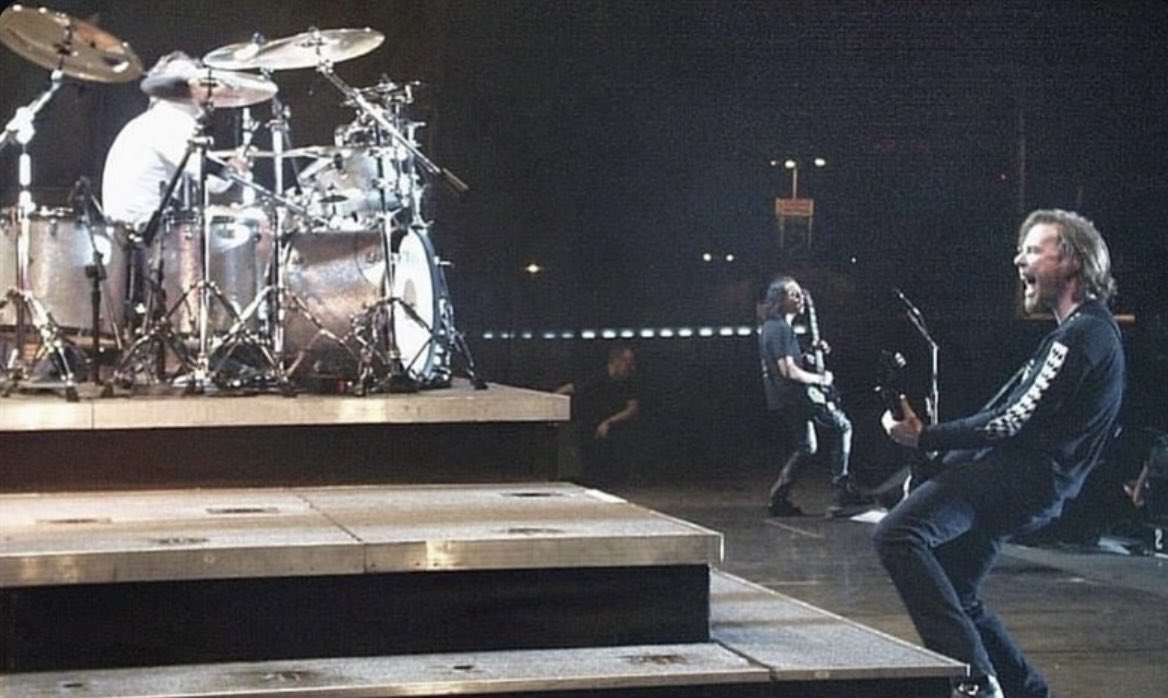
Once the chair incident had passed, which by various accounts did not lead to serious confrontations with security personnel or significant injuries, the night continued with Metallica taking the stage to deliver a set that, according to the official record available on the band's website, included twenty songs spread across a main set and three consecutive encores. The concert opened with Breadfan, the Budgie cover Metallica had popularized years earlier, and continued through a run that combined foundational pieces from their classic catalog — Master of Puppets, Of Wolf and Man, The Thing That Should Not Be, Fuel, The Memory Remains, Bleeding Me, The Four Horsemen, For Whom the Bell Tolls, King Nothing, Wherever I May Roam, One, and Fight Fire with Fire — with a three-part encore closing that proved particularly meaningful for the Mexican crowd. The first encore brought Nothing Else Matters and Sad But True, followed by a rendition of Creeping Death in which, as recorded in Metallica's official setlist archive, Phil Anselmo returned to the stage to join in on backing vocals, a gesture of camaraderie between both bands that condensed, in a single moment, the spirit of cooperation between two generations and two distinct strains of metal sharing that Mexican night. The second encore included Die, Die My Darling, a Misfits cover, and the unavoidable anthem Enter Sandman, while the third and final encore closed the evening with Battery, one of the fastest and most technically demanding songs in the band's early catalog, a closing choice that left the crowd in a state of physical exhaustion and accumulated euphoria after nearly three hours of uninterrupted performance across all three acts.
It's also worth gauging the material conditions under which that concert was organized, because they help explain why the mismatch between the venue's design and the crowd's behavior was so pronounced. The Foro Sol, inaugurated only a few years earlier as a multi-purpose venue capable of hosting both concerts and sporting events, was still in the process of figuring out the most appropriate setup formats for each type of show, and the decision to install anchored chairs in the floor area likely responded to a capacity-optimization and access-control logic closer to what was then applied at pop or ballad concerts — genres that dominated most of the mass-concert programming in Mexico during those years — than to what was demanded by a metal bill of that scale. Importing a setup scheme designed for a different kind of audience, without prior adjustments, ended up generating the tension that was released the moment Pantera took the stage, and the fact that the incident did not turn into a bigger tragedy, despite the size of the crowd and the intensity with which the chairs were removed, was due in large part to the more collective than aggressive nature of the movement described by witnesses, who insist on the image of an almost spontaneous coordination among thousands of strangers moving the furniture toward the sides of the venue rather than creating dangerous crowd crushes or violent scuffles with security staff.
It's important to underscore, in order to fully grasp the moment, that Anselmo's gesture of joining Metallica for Creeping Death was not a simple courtesy protocol between bands sharing a bill, but the public expression of a relationship of mutual respect between two bands that, coming from different aesthetic traditions within metal — thrash already mutated into a more massive, accessible sound in Metallica's case, rawer and more visceral groove metal in Pantera's — agreed on having each, in their own territory, been decisive to the evolution of the genre during the eighties and nineties. For a Mexican audience that had built its musical education through fanzines, cassette trading, and weekly visits to the Tianguis del Chopo, witnessing that crossover between two of their most important reference points live carried a symbolic weight that completely transcended the flying-chairs anecdote, even though that anecdote ended up traveling with the most force in the oral memory of those who weren't there. Media coverage of the event, it should also be said honestly, was relatively scarce by today's standards: in an era without phone cameras or social media, the visual and textual evidence of what happened that night remained scattered across specialized outlets with limited circulation, such as the now-defunct website Metal Grave México, which for years functioned as one of the few reliable sources for a detailed chronicle of the concert, supplemented by low-resolution photographs and the oral accounts that circulated among those who were actually there.
Before and After: The Legacy of April 30, 1999, in the Mexican Scene
The impact of that night wasn't limited to the nostalgic memory of those who were present; it had concrete operational consequences for the way large-format rock and metal concerts would be organized in Mexico from then on. The flying-chairs episode functioned, in practice, as an unofficial case study for the country's mass-event promoters: it was demonstrated conclusively, in front of tens of thousands of witnesses, that placing fixed furniture in the floor section of a metal concert was a logistical decision incompatible with the physical nature of that type of audience. Various music journalists who covered the scene in subsequent decades, such as Rogelio Matamoros, have noted that after that concert, concert promoters in Mexico learned the lesson that this type of event is high-risk when organized with chairs in areas meant for standing audiences, and indeed, the practice of setting up fixed seating in the floor sections of rock and metal concerts practically disappeared from the landscape of Mexico's live entertainment industry in the years that followed. That adjustment, which today might seem obvious and even minor in hindsight, represented at the time a paradigm shift in the relationship between promoters, venues, and civil protection authorities, who from then on began designing security protocols specific to metal and related-genre concerts, distinct from those applied to other kinds of mass musical events.
That operational learning coincided, moreover, with a broader moment of transition in the history of international concerts in Mexico, in which the country was beginning to establish itself as a recurring stop within the global circuits of rock and metal tours, leaving behind the status of occasional destination it had held through much of the eighties and early nineties. Metallica's own history in the country illustrates that consolidation: after the five dates in 1993 and the joint appearance with Pantera and Monster Magnet in 1999, the band returned a decade later, in 2009, with three concerts drawing nearly two hundred fifteen thousand people combined, shows documented on the release Orgullo, Pasión y Gloria, which the band itself framed as a kind of apology for the ten years that had passed without performing in the country. From then on, visits became more frequent, adding up, counting the most recent 2024 dates, to twenty-three concerts performed in Mexico over more than three decades — a record that makes the country one of the territories with the highest density of the band's appearances outside the United States and Europe, and one that is difficult to understand without considering the foundational role played both by the first 1993 visit and by the joint concert with Pantera in 1999 in building that long-term relationship.
For Pantera, on the other hand, that Mexican night represents a more bittersweet chapter in their history, precisely because they never performed in the country again as the original band. The group, already strained by internal tensions between the Abbott brothers and Phil Anselmo that would eventually lead to its official breakup in 2003, did not return to Mexico before splitting, and the tragic death of guitarist Dimebag Darrell, murdered onstage in Ohio in December 2004 during a concert with his subsequent project, Damageplan, permanently closed off any possibility of a reunion with the classic lineup. That makes the Foro Sol concert the only occasion on which Mexican audiences had the opportunity to see Pantera's original lineup — Anselmo, Dimebag Darrell, Rex Brown, and Vinnie Paul — sharing a stage live, which, as the years pass, adds an extra layer of historical, unrepeatable value to that date, far beyond the purely anecdotal curiosity of the flying chairs. Years later, with a new generation of fans who had grown up listening to the band's catalog without ever having had the chance to see them live, Pantera returned to Mexico in a tribute-and-reunion format: on December 2, 2022, at the Foro Pegaso in Toluca, Phil Anselmo and Rex Brown, the only surviving original members following the deaths of Dimebag Darrell in 2004 and Vinnie Paul in 2018, took the stage accompanied by Zakk Wylde on guitar and Charlie Benante, Anthrax's drummer, in a show that, significantly, was presented as this new incarnation of the band's first concert anywhere in the world, endorsed by both Abbott brothers' estates. The date chose as its stage the Hell and Heaven Metal Fest, a festival created in 2010 by a group of metal-loving businessmen from Guadalajara that, over the years, established itself as the biggest metal festival in Mexico and one of the most significant in all of Latin America, capable of bringing together on a single bill bands like Scorpions, Slipknot, Judas Priest, Megadeth, and KISS. That Pantera chose Mexico specifically, rather than the United States or a European country, to debut its new lineup worldwide was no mere logistical coincidence, but a decision that implicitly acknowledged the particular historical relationship the band had built with Mexican audiences since that single 1999 visit, and Zakk Wylde himself stated in interviews at the time that the goal of those dates wasn't to pass themselves off as the original Pantera, but to honor Dimebag and Vinnie Paul alongside Anselmo and Brown in a celebration of everything the band had achieved. In that sense, the festival that today serves as the recurring stage for Pantera's return to Mexico can be read, without stretching the interpretation too far, as a direct heir to that capacity for mass turnout for metal shows which the 1999 Foro Sol concert helped prove viable to the entire industry.
Beyond the operational consequences and the subsequent paths of both bands, the deepest value of that night for the Mexican scene has to do with its function as a generational meeting point and as symbolic validation for a community that, for years, had built its identity on the margins of the dominant commercial circuit. The same fans who had spent entire Saturdays combing through the stalls of the Tianguis del Chopo in search of photocopied fanzines, who had traded second- or third-generation recorded cassettes to discover bands that never played on commercial radio, and who had attended mid-tier shows at venues like Arena López Mateos hoping that one day they'd see their international idols on a stage worthy of their talent, found in that night at the Foro Sol a kind of public confirmation that their community, built underground over years, finally had the size, loyalty, and drawing power sufficient to justify two of the biggest bands in metal sharing a bill in their country. That kind of collective validation, hard to quantify but perceptible in the way the date is still invoked in chronicles, journalistic retrospectives, and conversations among fans more than two decades later, helped consolidate the international concert industry's confidence in the Mexican market as a viable, profitable, and loyal territory, laying the groundwork for the subsequent explosion of large-format metal festivals that today are a regular part of the country's cultural calendar.
It's also worth situating that episode within a broader process of maturation in Mexico's live entertainment industry that unfolded over the following decade. In the early nineties, bringing a band of Metallica's caliber to Mexico still represented a considerable financial gamble for any promoter, in a market where there was no certainty about the real drawing power of this type of show, nor about Mexican audiences' willingness to pay ticket prices comparable to those in other international markets. The success of the five 1993 dates, followed by the show of strength that came from gathering close to fifty thousand people for the joint concert with Pantera in 1999 — a figure that, despite the imprecision typical of records from that era, is consistent across the various journalistic and fan sources consulted for this chronicle — served as market evidence that was hard for promoters, managers, and international booking agencies to ignore. That evidence translated, in the years that followed, into a progressive normalization of Mexico within the touring itineraries of the biggest metal bands on the planet, a phenomenon that ran parallel to the strengthening of other Latin American markets such as Argentina, Chile, and Brazil, and which ended up establishing the region as its own circuit within the global heavy rock industry — no longer an occasional, risky stop, but practically a mandatory stop on any large-scale tour. Bands that make up the so-called Big Four of thrash metal — Metallica, Megadeth, Slayer, and Anthrax — were, at various points after that decade, part of that consolidation, and their recurring presence on Mexican soil, whether in individual shows or festival formats, is difficult to explain without considering the commercial credibility precedent left by, among other foundational dates, that night in 1999 at the Foro Sol.
Seen with the distance that more than twenty-five years provides, the night of April 30, 1999, condenses several stories that are worth not confusing with one another, even though they happened simultaneously on the same stage. There's the strictly musical story, that of a bill that brought together, at a moment of creative full strength for both bands, Metallica and Pantera performing repertoires now considered canon in modern metal, with a gesture of camaraderie between Anselmo and the host band still remembered as one of the most genuine moments of the evening. There's the logistical and operational story, that of the chair incident which, beyond its anecdotal weight, functioned as a catalyst for the later professionalization of how mass metal shows are organized in Mexico, with security protocols and space arrangements that finally acknowledged the particular physical nature of that kind of audience. And there is, finally, the symbolic story of a community — Mexican metalheads shaped by street markets, fanzines, hoyos funky, and cult radio stations — that found in that night a public confirmation of its own existence and drawing power, a hinge moment that helps explain why, decades later, Mexico became one of the most consistent markets for metal worldwide, capable of sustaining recurring tours by the genre's biggest bands and its own continent-scale festivals. None of these three stories fully exhausts the meaning of that date, but together they explain why, every April 30th, a considerable part of Mexico's metal community still pauses to remember the night Metallica and Pantera played together at the Foro Sol.
Anyone who attends a festival like Hell and Heaven today, with its polished production, standardized security protocols, and capacity to bring together dozens of top-tier international bands in a single weekend, can hardly imagine that much of that operational know-how has one of its roots in a night at the end of the nineties when no one yet knew exactly how to organize, with precision, a metal concert for tens of thousands of people in Mexico. The gap between that 1999 Foro Sol, with anchored chairs on the floor and fragmentary media coverage, and the current infrastructure of Mexico's metal concert industry, is the exact measure of a collective learning process that took years to consolidate, and one that would not have been possible without the uncomfortable, chaotic, and at the same time extraordinary precedent left by that date. Telling that story with precision, beyond the anecdote that tends to be repeated in simplified form, is also a way of honoring the generation of fans who built, from the margins, the conditions that made that moment possible, and of recording that Mexican metal did not reach the big stages by accident, but as the result of decades of collective, quiet, and persistent work, sustained by people who never stopped believing in the music they loved, even when their surroundings gave them little reason to.